

Only about 30% of visitors to Victoria Peak get the panoramic harbor view they came for. That figure isn’t pessimism — it’s what Hong Kong’s visibility data shows when you account for the city’s humidity cycles, seasonal haze patterns, and the peak’s elevation of 552 meters. The remaining 70% see varying degrees of obscured sky, cloud layers sitting below the observation deck, or a flat gray-white smear where Kowloon should be.
The gap between a good visit and a wasted trip has almost nothing to do with anything that happens after you arrive. It’s determined almost entirely by the month and hour you choose before you leave your hotel.
Month-by-Month Conditions at Victoria Peak
The most important thing to understand before booking anything: the number-one variable at Victoria Peak is not rain. Rain passes. Atmospheric haze, low-visibility fog, and sustained high-humidity air masses can sit over Hong Kong for weeks at a stretch. Victoria Peak’s elevation means it regularly punches above the cloud base — which sounds dramatic and appealing until you’re standing on the Sky Terrace 428 observation deck looking down at a solid white ceiling hiding the entire harbor below you.
The table below draws on Hong Kong Observatory climate normals. Visibility ratings reflect typical daytime horizontal visibility at peak elevation, not sea-level readings, which are consistently better and routinely mislead visitors who check standard weather apps.
| Month | Avg Temp (°C) | Avg Humidity | Typical Visibility | Crowd Level | Verdict |
|---|---|---|---|---|---|
| January | 16°C | 74% | Good | Moderate | Solid option |
| February | 16°C | 81% | Fair | Low–Moderate | Hit or miss |
| March | 19°C | 84% | Poor | Low | Avoid |
| April | 23°C | 87% | Poor | Moderate | Avoid |
| May | 27°C | 86% | Poor | High | Avoid |
| June | 29°C | 82% | Moderate | High | Risky |
| July | 29°C | 81% | Moderate | High | Typhoon risk |
| August | 29°C | 82% | Moderate | High | Typhoon risk |
| September | 28°C | 80% | Good after storms | High | Post-storm windows only |
| October | 25°C | 72% | Excellent | High | Best month |
| November | 21°C | 68% | Excellent | Moderate | Best month |
| December | 17°C | 67% | Very Good | High | Strong option |
The Spring Trap That Catches Most First-Time Visitors
March through May looks warm and inviting on paper. It’s a trap. Hong Kong’s spring is defined by moist southerly airflows that push humidity above 85% and compress atmospheric visibility to under 8 kilometers on most days. The peak sits inside a persistent haze band that absorbs the skyline from view. Visitors who arrive expecting a sharp harbor panorama often find themselves squinting at a gray-white smear where the Kowloon Peninsula should be.
Even the Peak Tram ride up — which has operated since 1888 and climbs at gradients up to 27 degrees — feels anticlimactic when the destination is a wall of fog. If spring is genuinely your only available travel window, monitor the Hong Kong Observatory’s real-time visibility data for the Peak weather station at hko.gov.hk before committing to the trip up. Below 10 kilometers: reconsider. Below 5 kilometers: skip it entirely.
Summer’s One Legitimate Window
June through September brings typhoons, sustained heat above 30°C, and the constant threat of a visit canceled by T8 typhoon signals — which shut down the Peak Tram and all outdoor operations with no flexibility. That said, summer has a narrow upside. In the 24 to 48 hours immediately following a typhoon’s passage, Hong Kong’s air washes out to extraordinary clarity. If a typhoon tracks through during your trip and the all-clear signal drops back to T3 or fully clears, get to Victoria Peak as quickly as you can manage. Post-storm visibility is among the best the city ever produces, and most visitors don’t know to act on that window, so crowds stay manageable.
Why October and November Are Decisively Better Than Every Other Month
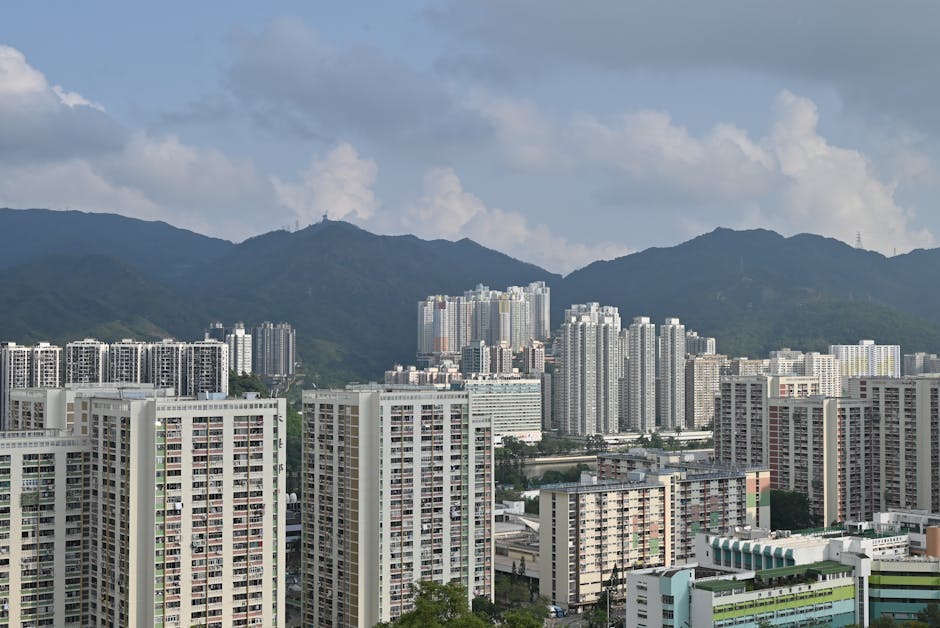
This is not a close call, and it’s worth being direct about it: October and November deliver a fundamentally different visit from any other time of year. The atmospheric shift that produces this difference is structural, not seasonal luck.
Hong Kong’s weather is governed by monsoonal patterns. The southwest monsoon dominates spring and summer, pulling humid marine air up from the South China Sea. In October, the northeast monsoon establishes itself, drawing drier, cooler continental air down from the Chinese interior. Relative humidity drops from the 80% range into the mid-to-low 60s. Particulate haze, which accumulates in stagnant summer air and has no mechanism for dispersal until wind patterns shift, clears out. The harbor sharpens into three dimensions.
From the Sky Terrace 428 on a clear October afternoon, you can see from the Kowloon waterfront in the north to Lamma Island in the south, with Lantau Island and the Tsing Ma Bridge visible to the west. That’s roughly 25 to 30 kilometers of unobstructed sight line. In May, the same view might extend 5 kilometers before washing into gray nothingness. That difference is the entire argument for timing your trip.
October: Accept the Trade-Off
October is Hong Kong’s most popular tourism month. The first week overlaps with mainland China’s National Day Golden Week holiday, which brings a substantial surge of visitors. Peak Tram queues on Golden Week weekends regularly run 60 to 90 minutes. That’s not an exaggeration — the tram holds around 120 passengers and departs every 10-15 minutes, but demand outpaces capacity on peak days.
The visibility, however, is near-certain. If you’re visiting Hong Kong once and you want to see the famous Victoria Harbour panorama from above, October is the month worth accepting those trade-offs for. Go on a Tuesday or Wednesday. Arrive before 10am. Buy Sky Terrace 428 tickets online in advance — walk-up purchase at The Peak Tower booth adds 20-30 minutes of unnecessary waiting.
November: The Better Answer If You Have Any Flexibility
If your travel dates aren’t fixed, November is the correct choice. The northeast monsoon is fully established and stable. Weekend crowds drop by roughly a third compared to October. Temperatures sit at a comfortable 20-22°C — cool enough that the Lugard Road Loop walk around the peak is genuinely enjoyable rather than a sweaty endurance exercise. The afternoon light turns warm and low-angle in November, which makes the harbor dramatically more photogenic than it appears under flat midday summer sun.
November also avoids the Golden Week surge entirely. Weekday mornings are among the least crowded you’ll experience at any major Hong Kong tourist site, and the views match or exceed October’s best days. For anyone with scheduling flexibility, November is the answer.
December: Excellent, With One Caveat
December holds its visibility well through most of the month, but introduces a new problem: radiation fog. Cold, still nights allow moisture to condense at altitude, and the resulting fog layers can sit at exactly peak elevation during the early morning. These typically burn off by 10am. Arriving at 11am or later eliminates most of this risk. Afternoons and evenings in December are excellent, and the city’s Christmas illuminations add a specific visual quality to the night view from the observation deck that doesn’t exist in other months.
Stop Choosing Between Sunset and Night
Arrive 90 minutes before local sunset. Stay until the full skyline illumination has settled in across Kowloon. That’s it.
The “day versus night” debate in travel forums misses the point entirely. The full transition — afternoon clarity, the dusk color shift over the harbor, then the stepwise illumination of the skyline — is what makes Victoria Peak worth the trip. A night-only visit after 8pm loses the dimensional depth of the harbor under natural light. A daytime visit that ends before 6pm misses the transformation entirely. The Sky Terrace 428 stays open until midnight. There is no reason to choose between the two when you can have both at no additional cost.
Sunrise visits exist and draw almost nobody. The trade-off is real, though: morning fog is more common than afternoon fog, particularly in winter, and you’re gambling on conditions that have had no chance to stabilize.
What Actually Ruins a Victoria Peak Visit
Most negative reviews of Victoria Peak share recognizable patterns. These four situations account for the large majority of disappointed visitors, and every one of them is avoidable.
- Visiting on a high-humidity day without checking visibility first. This is the most common and most preventable mistake. The Hong Kong Observatory publishes real-time visibility readings specifically for the Peak weather station. Anything below 10 kilometers means a compromised view. Below 5 kilometers, you’ll see almost nothing from the observation deck. Check within two hours of departure, not the night before — conditions shift faster than standard forecasts track.
- Queuing for the Peak Tram during the worst window. Weekend afternoons between 2pm and 5pm produce the longest queues. Minibus 15C from Edinburgh Place in Central runs the same route faster, costs around HKD $5, and drops passengers at the same upper terminus. Bus 15 from Exchange Square is the full-size bus alternative. Neither has a queue, and both get you to the same place.
- Skipping the Lugard Road Loop. The observation deck at The Peak Tower is the most visited viewpoint — and the most crowded. The Lugard Road Loop, a 3.5-kilometer circular walking trail that wraps the peak, offers longer, more varied sight lines to the north, south, and west with a fraction of the crowd density. In November, it’s one of the best urban walks in Asia. Visitors who confine themselves to the Sky Terrace 428 miss half of what makes Victoria Peak distinctive.
- Arriving during a typhoon signal period. T8 signals or higher shut down the Peak Tram, all cable services, and all outdoor attractions at Victoria Peak with no flexibility or exceptions. Check the HKO typhoon signal status before traveling, especially June through September. If a typhoon has just passed and the signal has dropped to T3 or clear, the opposite applies: go immediately, as post-storm clarity is exceptional and rarely lasts more than two days.
One additional note for visitors with children: Madame Tussauds Hong Kong operates inside The Peak Tower. It’s not the reason most people make the trip, but combo ticket packages combining the Sky Terrace 428 and Madame Tussauds are available at the Peak Galleria ticket counter and can reduce the overall cost for families who want a second activity on-site.
Practical Questions: Timing, Access, and What to Expect On the Ground

How much time should a Victoria Peak visit actually take?
Two hours is the minimum for a straightforward Sky Terrace 428 visit. Three hours is more realistic if you include the Lugard Road Loop and the full sunset-to-night observation window. If you’re committing to the full experience — trail walk, observation deck, and staying through skyline illumination — plan four hours on site. Add travel time: the Peak Tram takes about 8 minutes from the Lower Terminus on Garden Road once you board, but queuing typically adds 20 to 50 minutes depending on the day and time.
Does the day of the week make a meaningful difference?
Considerably. Tuesday through Thursday are the quietest days, with shorter tram queues and noticeably more space on the observation deck. Saturday afternoons in October during Golden Week represent the maximum-density scenario — that specific combination is worth avoiding if you have any scheduling flexibility. Weekday mornings in November combine excellent visibility with the thinnest crowds of the year.
Can weather conditions shift significantly during a visit?
Yes, and quickly. Victoria Peak’s elevation makes it sensitive to atmospheric changes that don’t register at sea level. A clear afternoon can transition to fog within 30 to 40 minutes if a weather front moves through. Conversely, morning fog often burns off by 10am. If you arrive to foggy conditions before 10am in December or January, waiting 45 minutes on-site sometimes pays off. In spring, waiting rarely helps — the haze is systemic and atmospheric, not a localized cloud layer that will drift through.
Is the Sky Terrace 428 ticket worth the entry price?
The Sky Terrace 428 costs around HKD $98-118 for adults depending on the booking channel (online is consistently cheaper). The additional elevation it provides over the free observation area at The Peak Tower’s lower floors is roughly 30 meters — enough to clear some foreground obstruction and widen the visible horizon. On a clear October or November afternoon, yes, that difference is worth the cost. On a hazy spring day when visibility is already below 8 kilometers, the additional height doesn’t rescue the view. The decision should be conditional on visibility conditions, not on sunk-cost pressure from having already traveled to the peak.
Victoria Peak is one of the few urban viewpoints where the experience quality ranges from genuinely world-class to actively disappointing depending entirely on timing. As Hong Kong continues refining its tourism infrastructure — expanded tram capacity, improved Lugard Road trail access, and broader integrated ticketing across Peak Tower attractions — the logistics will keep getting easier. The atmospheric window that makes the harbor view extraordinary will stay exactly what it has always been: reliable in autumn, unpredictable in winter, and largely unavailable in spring.